Gamers Against Visa Censoring Games: The Community’s Response
“Gamers against Visa censoring games” sounds dystopian, I know. So what's Visa's deal? Are they really censoring games? How could they—aren’t they just a payment processor? Why should they have any say in whether I can buy a hentai game? Why does Steam listen to them? And why does the government allow this?
Unfortunately, this isn't science fiction, fellow degenerates. This is exactly what's happening right now, and why you should be worried.
In case you’ve been living under a rock: in July 2025, fans of adult games witnessed an unprecedented assault on their freedom when Visa and Mastercard threatened Steam and Itch.io with the removal of their payment processing capabilities. As a result, both platforms folded quickly and have since removed and banned adult games from their stores. You can read more about the details in this article.
Since then, there have been some developments. The gaming community hasn’t stayed silent (when have we ever, really?), so here’s what’s been going on: how gamers reacted, Visa’s response, and what governments have done—or could do. (Spoiler: you’ll be disappointed.)
The Gaming Community Fights Back
You mess with spicy games, you get Gamers Against Visa Censoring Games. This is how we're fighting back:

Organized Email Campaigns
Steam users began banding together to contact Visa over the removal of adult games, launching coordinated email campaigns to pressure the payment processor to reverse its position. The response was swift and widespread, with thousands of gamers writing directly to Visa and Mastercard executives demanding explanations for their interference in legal content distribution.
Visa replied, by the way, but more on that later.
Petitions Gain Massive Momentum
Petitions are blowing up, with anti-censorship activists mobilizing across multiple platforms. An old petition from the American Civil Liberties Union calling for Visa and Mastercard to cease their attempts to censor adult content has resurfaced, and we also have a Change.org petition. Check these out, and sign if you agree:
- Change.org Campaign: A petition targeting Mastercard, Visa, and activist groups to “stop controlling” content
- ACLU-backed Petition: Focusing on the broader civil liberties implications
These petitions have gained thousands of signatures overnight.
Developer and Creator Mobilization
Developers have urged people to demand that Visa and Mastercard cease their attempts to censor adult content, with many creators taking public stands against the financial censorship.
Independent developers, in particular, have been vocal about the threat this represents to their livelihoods and creative freedom. Many have begun exploring alternative payment processors and distribution methods to reduce dependence on Visa and Mastercard’s infrastructure.
So, beyond petitions and wishful thinking… is there really no hope?
Not at all. Let’s see how Japan fought (and won) against VISA.
Japan Actually Did Something
Visa has repeatedly targeted Japanese creative platforms—particularly those selling anime, manga, and erotic content. Major adult-oriented platforms like DLsite, Melonbooks, Toranoana, and developers like Yuzusoft have all had Visa (and sometimes Mastercard) payments suspended, especially when content included genres deemed “problematic” by Visa.
In response, in July 2024 Japan’s antitrust regulator, the Japan Fair Trade Commission (JFTC), launched an investigation into Visa Worldwide Japan for suspected abuse of market dominance—accusations included charging higher fees to clients using rival systems, pressuring businesses to migrate to Visa’s platform, and generally restricting competition via coercion.
By July 2025, they issued their first-ever administrative action against a credit card firm. Visa avoided monetary penalties (for now) by submitting a voluntary corrective action plan, but they'll be monitored for the next five years.
Hey, looks like something can be done about it if the government really wants to… So why do our governments in the West do nothing about it?
Why Governments in the West Don't Act
This is where the story gets frustrating, fellow cultured gentlemen. Japan acted. The US, Canada, and UK? They've done nothing.
Why is that, exactly? Why won’t Western governments lift a finger?
The sad truth: they don’t want to. They’re in bed with the payment processors.
Visa and Mastercard spend millions lobbying Congress and regulatory bodies every year. In fact, around 70% of Visa’s lobbyists are former U.S. government officials. For Mastercard, it’s between 63% and 66%.
Why does that matter? Because when the people who are supposed to keep powerful companies in check used to work for those companies—or want a job with them later—it’s a huge conflict of interest.
Instead of protecting the public, these “regulators” often end up protecting the corporations they’re supposed to oversee. That’s how companies like Visa get away with censoring content, crushing competition, and silencing creators—the goverment knows this, and actively allows it.
Also there's the issue of economic dependence. Government disbursements, tax payments, and procurement all flow through Visa/Mastercard networks. Interfering with these companies would mean restructuring large parts of public finance systems… Basically, it's a mess, and goverments don't want to risk losing their tax money, do they?
That's why Visa and Mastercard operate as a functional cartel, and Western governments benefit from maintaining this status quo rather than protecting their citizens' rights.
Visa's Response So Far: Generic and Insulting
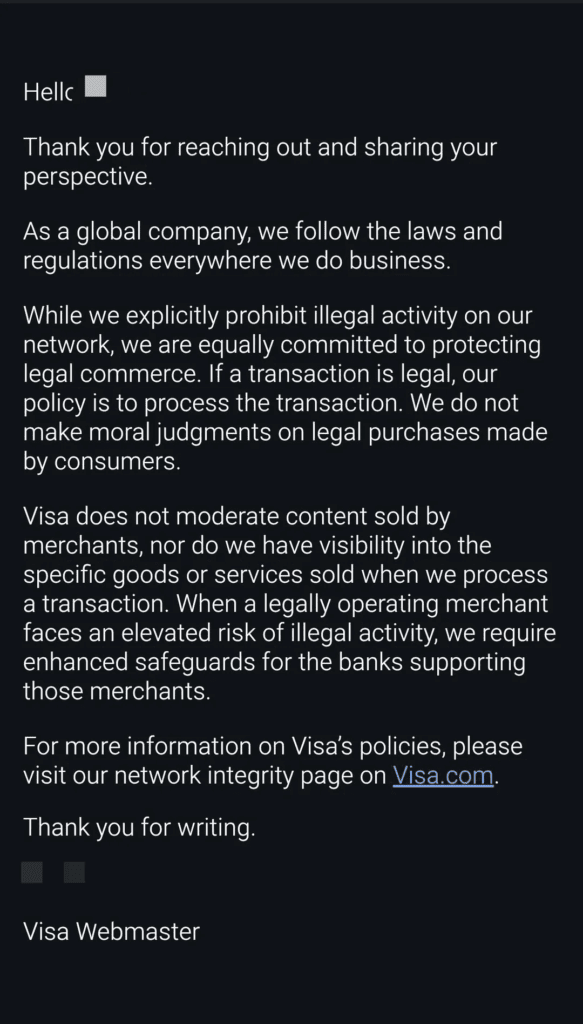
When gamers against visa censoring games started making noise, Visa finally responded. Their official line was… disappointing.
What They Actually Said
Reports from gamers who contacted Visa directly revealed standardized responses that felt like they were written by corporate lawyers trying to avoid admitting anything. These responses typically included risk management justifications, citing concerns about chargebacks and fraud in adult content sectors. They referenced vague internal policy compliance requirements about content standards that nobody could actually find or read.
Most insulting was their denial of censorship – claiming they don't engage in censorship while simultaneously pressuring platforms to remove legal content. When pressed for specifics, they deployed classic corporate deflection to platforms, suggesting that content decisions are made by the platforms themselves, not payment processors.
Check this out:
Why These Responses Are Bullsh*t
Let's be real about this, because their explanations don't hold water. Active pressure was documented when Valve confirmed that credit card companies pressured them to delist games. This directly contradicts their claims that platforms make independent decisions – we literally have proof they're lying.
The selective enforcement is equally ridiculous. They target adult gaming content while ignoring similar risk profiles in other industries. Funny how gambling apps and crypto exchanges don't get the same treatment, despite having much higher fraud rates.
What really gives away the game is the coordinated action across multiple platforms. The simultaneous pressure on Steam, Itch.io, and others suggests coordinated policy implementation, not independent platform decisions. You don't get that kind of timing by accident.
But the most damning aspect is the international overreach. Their ability to “censor another country's free speech” through payment control demonstrates a global scope that completely bypasses democratic processes and national sovereignty. Still, here's how you can keep getting your pervy goods from Japan thanks to proxy buying, just in case you need it.
So What You Can Actually Do?
Recent developments have shown us that, unfortunately, whoever controls the infrastructure of digital commerce controls what we can consume. Right now, it’s payment processors—working hand-in-hand with governments—deciding that we can’t buy our hentai games or spicy manga.
Tomorrow? It could be anything: how many cigarettes you’re allowed to buy, how much meat you can eat, what books you can purchase—and which ones are deemed to contain “harmful” ideas.
You might laugh now, but this has happened before. And it can happen again.
That’s why the European Union is pushing for digital currencies like the digital euro. It’s why governments are wary—even hostile—toward cryptocurrency. They know what they’re doing. These giant corporations and government agencies? With the revolving door between them, you could argue they’re one and the same. These monopolies aren’t just influencing the government—they’re becoming the government.
The mechanism is already in place. The precedent is being set.
This is about far more than spicy anime games—it’s about who gets to decide what we can access online and irl, and whether that power rests with democratically accountable institutions or unelected corporate executives.
So what do we do?
We must join organized resistance, vote in new governments, and speak out.
Your wallet is a weapon in this fight. Boycott platforms that cave to payment processor pressure without a fight. Support creators and platforms that stand up to censorship, even when it costs them money. Use your purchasing power to support freedom of expression over corporate convenience.
And if they keep pushing? Leave the fascist country—and keep fighting from abroad.
This may have started with gamers against visa censoring games, but it won’t stop there. It will grow into citizens having to fight for their most basic rights.
Remember: we didn’t always have these rights. We had to fight for them.
And they’re more than willing to take them back from us.
We won’t let them.